


Snooker Rules Explained: How a Frame Works, From the Break to the Final Black
What are the rules of snooker? Ball points, the colour order, the table layout, fouls, the miss rule and free balls, without the rulebook jargon.
By Jordan Willmott, Sportsbook Experience Senior Manager at Midnite
Last updated: 15/09/2026
The basic snooker rules: players take turns to pot a red ball, worth 1 point, then a colour, worth 2 to 7, and keep alternating until all 15 reds are gone. Then the six colours are potted in order, yellow to black. The player with the most points wins the frame.
The rest is what fills 17 days at the Crucible: fouls, misses, snookers and a lot of people in waistcoats thinking very hard.
What are the rules of snooker?
The rules of snooker come down to potting balls in the right order: a red, then a colour, repeated until the reds have gone, then the colours from yellow to black. Every ball has a points value, the highest score wins the frame, and a foul hands your opponent between 4 and 7 points.
A player's turn is a visit to the table, and the points scored in one visit are a break. You keep playing until you miss a pot or commit a foul, and then it's your opponent's turn.
Those basic rules of snooker come from the WPBSA, the sport's world governing body, whose rulebook covers everything from the professional tour to club leagues.
How is a snooker table set up?
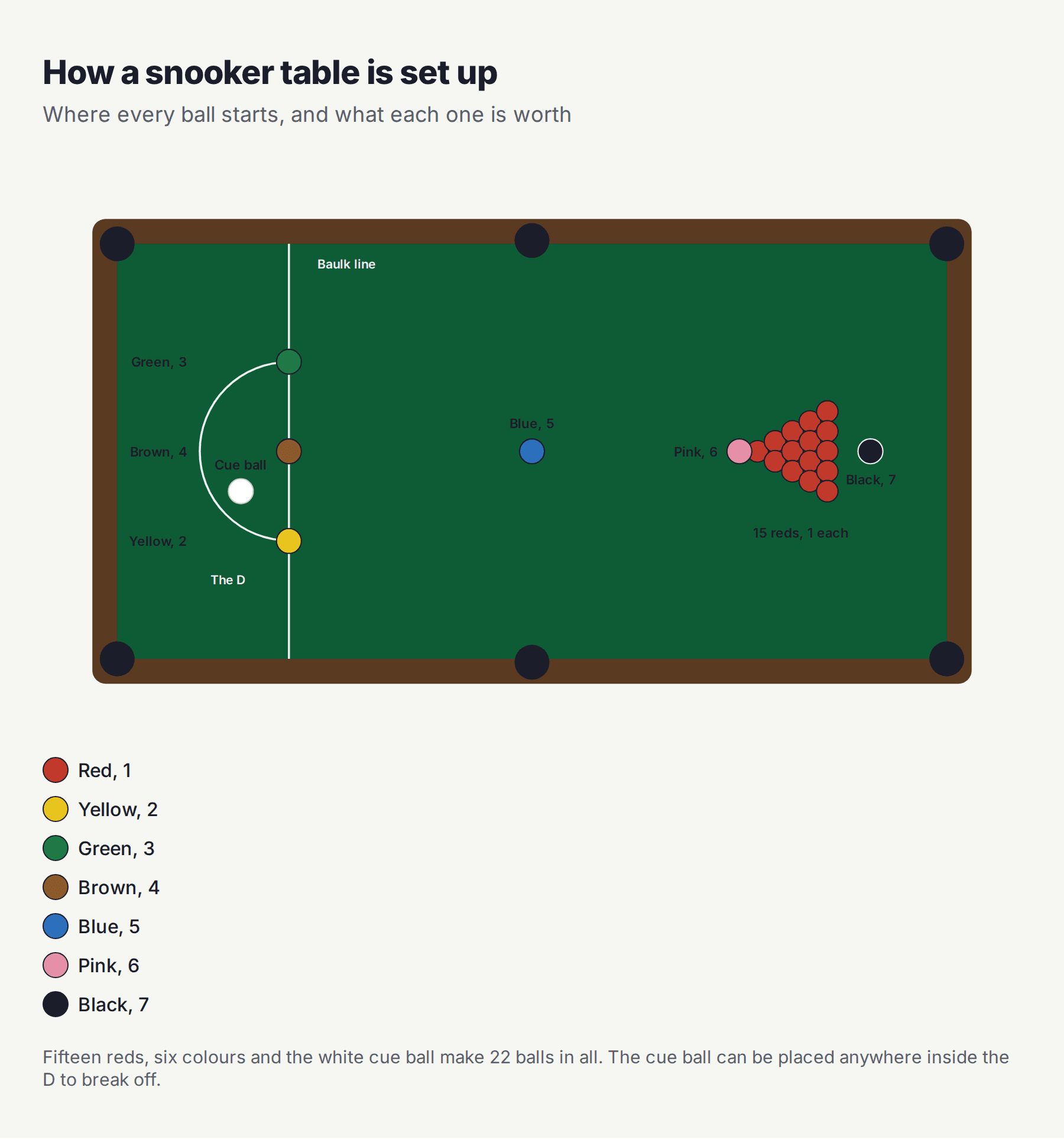
A snooker table is set up with the 15 reds packed in a triangle behind the pink, and the six colours on their own spots. The yellow, brown and green sit on the baulk line, with the brown in the middle and the yellow and green at either end of the D. The blue goes in the centre of the table, the pink just in front of the reds, and the black near the top cushion.
So how many red balls are on a snooker table? Fifteen, plus the six colours and the white cue ball, which makes 22 in all.
The snooker starting position for the cue ball is anywhere inside the D, the semicircle behind the baulk line. The player breaking off places it there and plays into the pack of reds, usually just clipping the side to send the white back up the table.
How many points is each snooker ball worth?
Snooker ball points run from 1 for a red to 7 for the black. The snooker colour order, lowest to highest, is yellow, green, brown, blue, pink, black.
The snooker colours order matters twice: it tells you what each pot is worth, and it's the sequence the colours have to be cleared in at the end of the frame.
What order do you pot the balls in?
The snooker potting order has two phases. While reds remain, you pot a red, then any colour, then a red, and so on, with every potted colour put back on its spot. Once the last red has gone, the colours are potted in ascending order, yellow first and black last, and this time they stay down.
After the final red, you get one more free choice of colour before the sequence starts. That colour is re-spotted, and then it's yellow, green, brown, blue, pink, black.
If you pot two reds in one shot, both count, so that's 2 points and you're still on a colour. If the colour you're going for isn't obvious, you nominate it to the referee first.
What counts as a foul in snooker?
A foul in snooker is any shot or action that breaks the rules, and it ends your turn and gives your opponent penalty points. The common ones are missing every ball, hitting the wrong ball first, potting the white (going in-off), potting a ball that isn't on, and touching any ball with anything other than the tip of the cue.
Knocking a ball off the table and playing with both feet off the floor are fouls too.
How many points is a foul?
A foul is worth a minimum of 4 points to your opponent, rising to 5, 6 or 7 when the blue, pink or black is involved. The penalty is whichever is highest: 4, the value of the ball you were on, or the value of a ball wrongly hit or potted. Snooker foul points never go above 7 for a single shot, and points already scored earlier in the break still count.
What is a foul and a miss?
A foul and a miss is called when the referee judges that a player didn't make a good enough attempt to hit the ball on. The opponent gets the penalty points and can ask for the balls to be put back where they were, so the player has to try the same shot again.
It's the rule behind those long sequences of attempts to escape a snooker, with the scoreboard ticking up four points at a time.
Is it a foul if you don't hit a cushion?
No. Snooker has no rule that a ball has to reach a cushion after contact, so a gentle roll up to a red is a perfectly legal safety shot, as long as the cue ball hits the ball on first.
What is a snooker, and what is a free ball?
A snooker is a position where the cue ball can't hit the ball on in a straight line because another ball is in the way. Laying one is how a player forces their opponent into a foul or a loose escape.
A free ball comes after a foul leaves the next player snookered. They can nominate any ball as the ball on, and it scores the value of the ball it's standing in for. So if you're on a red and snookered after a foul, you can nominate the blue as a free ball, and potting it counts as a red, worth 1.
How do you win a frame and a match?
You win a frame of snooker by finishing it with more points than your opponent, either by potting the final black with the lead or when the other player concedes because they can't catch up. Matches are played over a set number of frames, first to a target, and the World Championship final is the longest of all, over two days.
A player who's behind with too few points left on the table needs snookers: they have to lay snookers to win penalty points before they can catch up. When the gap is bigger than everything left, players usually concede.
If the scores are level after the final black, the black is re-spotted. The players toss for who goes first, the cue ball is played from the D, and the next score or foul decides the frame.
What is a maximum break?
A maximum break in snooker is 147: all 15 reds each followed by the black (120 points), then all six colours (27 points) in a single visit. It's snooker's nine-darter, the one thing that makes a quiet session suddenly very loud. (For the darts version, see our darts rules guide.)
A break above 147 is possible, just about. If a player is awarded a free ball before any reds have gone, the free ball counts as an extra red, which takes the theoretical maximum to 155.
Could the cue ball ever be a different colour?
The cue ball in snooker is white under the official rules, which list a white among the balls used in the game. That didn't stop World Snooker Tour announcing, two days before 1 April 2026, that the cue ball at the World Championship would be neon green in Midnite's colours, as the tournament's official UK betting and casino partner.
Plenty of fans checked the date. It was an April Fool, and the white ball stayed exactly as it was. We've told the full story of the neon green cue ball on the blog.
How does snooker betting work?
Snooker betting markets follow the rules above. The most common are:
- Match winner: who takes the match.
- Correct score: the exact result in frames.
- Frame handicap: a player starts with a head start or a deficit in frames.
- Total frames: over or under a set number of frames in the match.
- Highest break: which player makes the bigger break.
- Century breaks: whether there's a break of 100 or more, or how many.
- 147 in the match or tournament: whether anyone makes a maximum.
The rules decide the detail: a century is 100 or more in one visit, and a 147 needs every red with a black. Nothing on this page makes any of those results more predictable, and our tips for the World Championship and the Masters are opinions, not certainties. If you're new to the prices, here's betting odds explained.
FAQs
What is the 3 miss rule in snooker?
The three miss rule applies when a player has a clear, full-ball hit on the ball on and misses it. After a second miss, the referee warns that a third will cost the frame. If the player misses again, the frame is awarded to their opponent, whatever the score.
What happens if you sink two coloured balls in snooker?
Potting two colours in one shot is a foul when a colour is the ball on, so neither scores and your opponent gets penalty points: 4 minimum, or the value of the higher colour. Potting two reds in one shot is different, and both count.
What are the official rules of snooker?
The official rules of snooker are published by the WPBSA, the World Professional Billiards and Snooker Association, and apply from the professional tour down to club leagues. The current edition of the rulebook was released in September 2024.
What happens if you don't touch a ball in snooker?
Failing to hit any ball is a foul worth at least 4 points to your opponent, or the value of the ball on if that's higher. If the referee thinks you could have hit it, they'll also call a miss, and your opponent can have the balls put back.
Frame ball
Red, colour, red, colour, then yellow to black. Once you've got that straight, the rest of the rules are much easier to follow.
Enjoy the snooker, and if you bet on it, keep it to money you're happy to spend on a day's viewing. Put your spending and loss limits in place before the session starts, and our Responsible Play pages have every tool we offer. We're licensed and regulated by the Great Britain Gambling Commission. 18+, please gamble responsibly.
About the author
Jordan Willmott is Sportsbook Experience Manager at Midnite, where he leads the team behind sportsbook operations and propositions, from bet settlement and price boosts to the range of markets and specials available across every sport on site. He has spent 13 years in sportsbook and trading, previously in similar roles at BetVictor, Sporting Index and Sky Betting & Gaming. He writes here on how markets are built, made available and settled once the whistle goes. Connect with Jordan on LinkedIn



Company
Help
Product
Support
Payment Methods


Play Responsibly
Midnite is operated by Dribble Media Limited for customers in Great Britain, licensed and regulated by the Great Britain Gambling Commission (Account No. 42647 ) and Midnite Europe Limited for customers in Ireland, licensed by the Gambling Regulatory Authority of Ireland (Licence No. GRAI-0767-RB-26-0001 ).
Dribble Media Limited is incorporated under the laws of England and Wales, with Company Registration No.09555672, and registered address at 86-90 Paul Street, London, EC2A 4NE United Kingdom. Midnite Europe Limited is incorporated under the laws of Malta, with Company Registration No.C90791, and registered address at Level 3 (suit 2327) Tower Business, Tower Street, Swatar Birkirkara BKR4013, Malta. Please play responsibly, for more information and advice visit: www.begambleaware.org or www.gamblingcare.ie


