


Darts Rules Complete Guide: How 501 Works, From the Oche to the Final Double
How do darts rules work? Starting on 501, scoring, the double-out finish, the oche distance, legs vs sets, and the numbers you can't check out from.
By Jordan Willmott, Sportsbook Experience Senior Manager at Midnite
Last updated: 15/09/2026
The basic darts rules are simple: each player starts on 501, throws three darts a turn, and subtracts what they score until they reach exactly zero, finishing on a double or the bullseye. Score more than you need and you bust, and that turn doesn't count.
Everything else is a question of how quickly you get there, and whether your arm holds up on double 16.
What are the rules of darts?
The rules of darts in its standard 501 game: two players take turns to throw three darts, subtract each turn's score from 501, and race to exactly zero. The final dart must land in a double or the bullseye. Go below zero, or leave yourself on 1, and you bust.
Each set of three darts is called a visit. The first player to check out wins the leg, and matches are won by winning a set number of legs, or sets of legs, depending on the event. Players take turns to throw first in each leg.
Those are the same rules the professionals play under. The PDC's rules set out 501, three-dart visits and the double-out finish as the standard for its tournaments.
How does darts scoring work?
Darts scoring works by segment: the board is split into 20 numbered sections worth 1 to 20 points, with a thin outer ring that doubles the number and a thin inner ring that trebles it. The bull in the middle scores 25 for the outer green ring and 50 for the red centre.
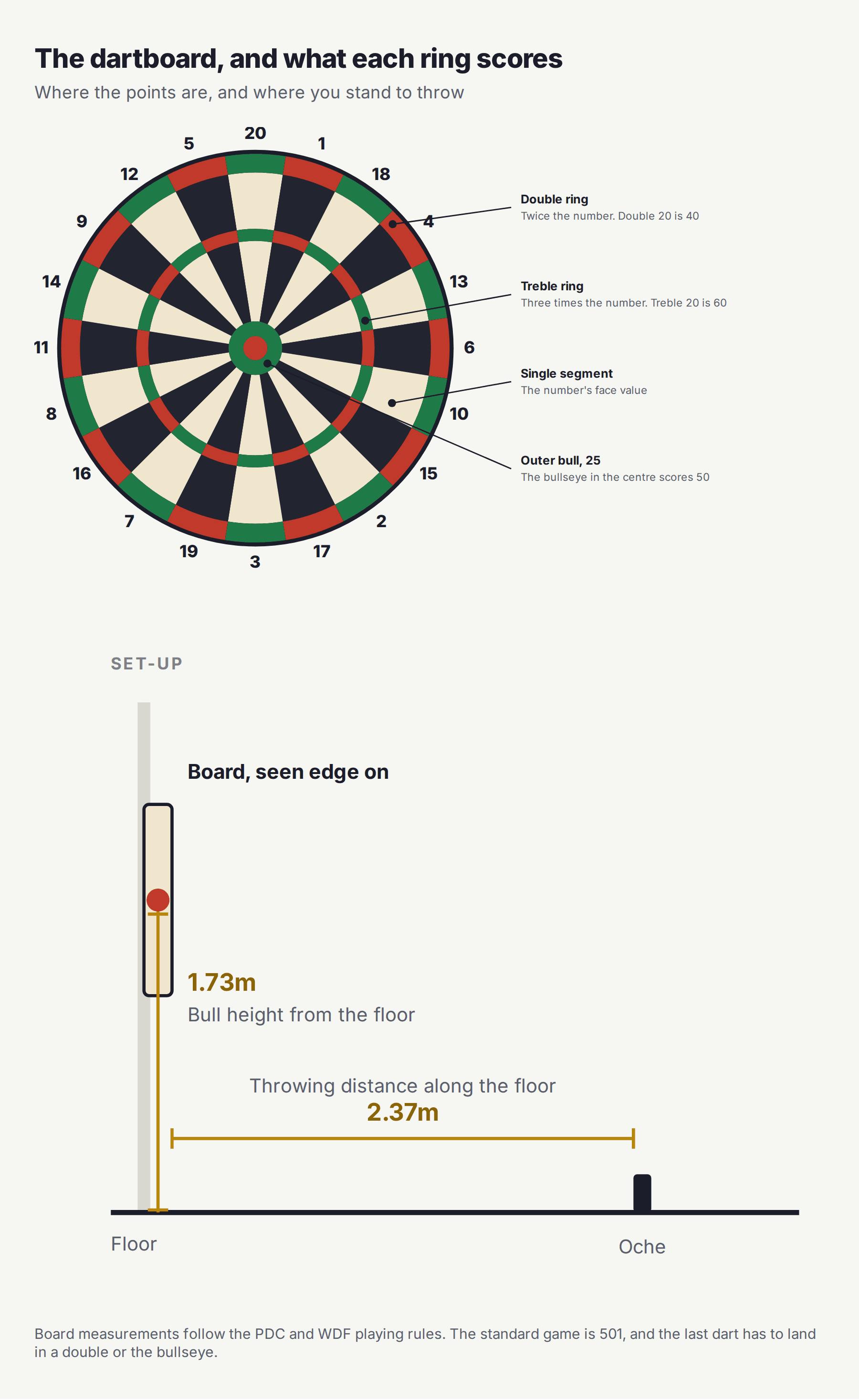
So darts points break down like this:
- Single segment: the number's face value.
- Double ring: twice the number, so double 20 is 40.
- Treble ring: three times the number, so treble 20 is 60.
- Outer bull: 25.
- Bullseye: 50.
A dart that lands outside the double ring scores nothing.
How much is a bullseye in darts?
A bullseye is worth 50 points in darts, and the green ring around it, the outer bull, is worth 25. The 50 counts as a double, which is why it can finish a leg. The 25 doesn't.
What is the highest score with three darts?
The highest score with three darts is 180: three darts in the treble 20. It's the number the crowd at Ally Pally spends all night waiting for.
What number does darts start at?
Darts starts at 501 in the standard game played on TV and in most leagues, counting down to zero. Shorter games start at 301, a common choice for casual play, and the rules are the same with less to get through.
Some players add a double-in rule to 301, which means your score only starts counting once you've hit a double. In professional darts, that rule turns up at one major event, covered in the formats table below.
How far is the oche from the dartboard?
The oche is 2.37 metres (7ft 9.25in) from the face of the dartboard in steel-tip darts, and the centre of the bullseye sits 1.73 metres (5ft 8in) off the floor. Both measurements are set in the PDC's rules and the World Darts Federation's playing rules, and they're the same for everyone.
A quick way to check a board at home is the diagonal: from the front of the oche to the centre of the bull should measure 2.93 metres. Soft-tip electronic boards use a longer oche, at 8ft.
Your feet have to stay behind the oche while you throw. Leaning over it is fine. Stepping on it isn't.
How do you finish a game of 501?
You finish a game of 501 by hitting a double, or the bullseye, with the dart that takes your score to exactly zero. On 40, that's double 20. On 50, it's the bullseye. On 32, it's double 16, which is why so many players try to leave that number.
The highest possible checkout is 170: treble 20, treble 20, bullseye. And not every score under 170 can be finished in three darts. 169, 168, 166, 165, 163, 162 and 159 are the so-called bogey numbers, where no combination of three darts gets you out.
What is a bust?
A bust is when a player scores more than they need, leaves exactly 1, or reaches zero without finishing on a double. The turn ends there, and the score goes back to what it was at the start of that visit. You can't finish from 1, because there's no double worth 1 point.
How do legs and sets work?
A leg is a single game of 501, and a set is a group of legs, usually first to three. Most professional events are decided in legs, with the first player to reach a target number winning the match. A few are played in sets, including the PDC World Championship.
The formats vary more than most viewers realise:
The World Grand Prix's double-in rule is the one that catches new viewers out. Players can throw three darts and score nothing at all, because the scoring only starts with a double. The PDC confirms it's currently the only tournament played that way.
You can follow all of them on the darts section of the Midnite sportsbook.
What are the rules at a professional darts match?
Professional darts adds a few rules on top of the basics. Players throw at the bull to decide who starts, a dart has to stay in the board to count, and a player's feet must stay behind the oche for every throw.
- The bull-up: each player throws one dart at the bull, and the closest throws first in the opening leg.
- Bounce-outs: a dart that bounces off or falls out of the board scores nothing, and it can't be thrown again.
- The referee calls the scores, and the score stands once the darts have been pulled out of the board, which is why players check the board before retrieving.
What other darts games can you play?
501 is the standard, but a board supports plenty of other games, and most pub regulars know at least two.
- 301: the same as 501 with a lower starting score, often played with a double-in rule.
- Cricket: players close out the numbers 15 to 20 and the bull by hitting each three times, scoring on numbers they've closed that their opponent hasn't.
- Around the Clock: hit every number from 1 to 20 in order, and the first to finish wins.
How does darts betting work?
Darts betting markets are built on the same rules: who wins, by how much, and what happens along the way. The most common are:
- Match winner: who wins the match.
- Correct score: the exact result in sets or legs.
- Handicaps: a player starts with a head start or a deficit in legs.
- 180s: the total number in a match, or which player hits more.
- Highest checkout: the biggest finish in the match.
- Nine-dart finish: whether anyone completes a leg in the minimum nine darts.
A nine-darter carries a big price because it hardly ever happens. What happened in the last leg doesn't make one more likely in the next.
Our PDC darts betting tips are opinions on upcoming matches, not certainties. For how the prices work, see betting odds explained, and for boosted prices, odds boosts.
FAQs
What is the distance from a dart board?
The distance from a dartboard to the oche is 2.37 metres (7ft 9.25in) in steel-tip darts, measured from the face of the board. The centre of the bullseye sits 1.73 metres (5ft 8in) off the floor.
Can you finish on Bull with 50 left?
Yes. The bullseye counts as a double, so with 50 left one dart in the bull finishes the leg. The outer bull, worth 25, isn't a double and can't finish a leg.
How many sets do you need to win a game of darts?
It depends on the event. At the PDC World Championship, players need three sets to win an early-round match and seven to win the final, with each set first to three legs. Most other professional events are played in legs rather than sets.
What numbers can't you hit in darts?
You can't finish a leg in three darts from 169, 168, 166, 165, 163, 162 or 159, and nothing above 170 can be finished in one visit. Some three-dart totals are impossible to score at all, including 179, 178, 176, 175, 173 and 172.
Game on
Start on 501, count down, finish on a double.
If you bet on the darts, decide on your stake before the walk-ons and keep it the same whatever happens on the doubles. Set your spending and loss limits in your account first, and find the full set of tools on our Responsible Play pages. Midnite holds a Great Britain Gambling Commission licence and is regulated by the Commission. 18+, please gamble responsibly.
About the author
Jordan Willmott is Sportsbook Experience Manager at Midnite, where he leads the team behind sportsbook operations and propositions, from bet settlement and price boosts to the range of markets and specials available across every sport on site. He has spent 13 years in sportsbook and trading, previously in similar roles at BetVictor, Sporting Index and Sky Betting & Gaming. He writes here on how markets are built, made available and settled once the whistle goes. Connect with Jordan on LinkedIn



Company
Help
Product
Support
Payment Methods


Play Responsibly
Midnite is operated by Dribble Media Limited for customers in Great Britain, licensed and regulated by the Great Britain Gambling Commission (Account No. 42647 ) and Midnite Europe Limited for customers in Ireland, licensed by the Gambling Regulatory Authority of Ireland (Licence No. GRAI-0767-RB-26-0001 ).
Dribble Media Limited is incorporated under the laws of England and Wales, with Company Registration No.09555672, and registered address at 86-90 Paul Street, London, EC2A 4NE United Kingdom. Midnite Europe Limited is incorporated under the laws of Malta, with Company Registration No.C90791, and registered address at Level 3 (suit 2327) Tower Business, Tower Street, Swatar Birkirkara BKR4013, Malta. Please play responsibly, for more information and advice visit: www.begambleaware.org or www.gamblingcare.ie


