Horse Racing Form Guide: How to Read a Racecard Line by Line
How to read a horse racing form guide: figures, letters, OR, RPR and Topspeed, one fully annotated racecard line, and where to find free form in the UK.
By Jordan Willmott, Sportsbook Experience Senior Manager at Midnite
Last updated: 6/11/2026
Look at any racecard and the horse racing form guide is the string of figures by each horse's name: its finishing positions, latest run on the right. The ratings and letters around those figures cover course, distance, going and headgear. Midnite's horse racing cards show the figures too.
What Is a Horse Racing Form Guide?
A horse racing form guide is everything a full racecard lists against a runner: form figures, days since its last run, official rating, independent ratings such as RPR and Topspeed, course and distance wins, and headgear. Whether a site calls it a racing form guide or a horse betting form guide, it reads the same way.
The Midnite Take: Reading Horse Racing Form: Those Numbers Actually Mean Something
By Dave Learmont, Creative Copy Lead at Midnite
Ever looked at a racecard and wondered why a horse has what looks like a dodgy Wi-Fi password next to its name?
That's its form. Those numbers and letters tell you how a horse has performed in previous races.
A 1 means it won, a 2 means it finished second, and a 0 generally means it finished tenth or worse. You'll also spot letters like F for fell and P for pulled up.
But form is only part of the picture. Ground conditions, race distance and opposition all matter.
A horse that loves soft ground might have a very different afternoon when the sun comes out.
How Do I Read a Horse Racing Form Guide?
Read one runner at a time, left to right across the line, and start the form figures from their right-hand end. It's a lot of characters for one horse, and every one of them is doing a job. Here's a full line for an invented jumps horse, laid out the way most UK form sites show it. Midnite's own racecards keep it simpler, with form figures, age, weight, jockey and trainer, so the ratings and codes below are what you'll find on form sites such as Racing Post.
4 Not A Real Horse 21 b1 CD BF | Form: 23-P142 | Age: 7 | Weight: 11-4 | OR: 128 | RPR: 134 | TS: 121
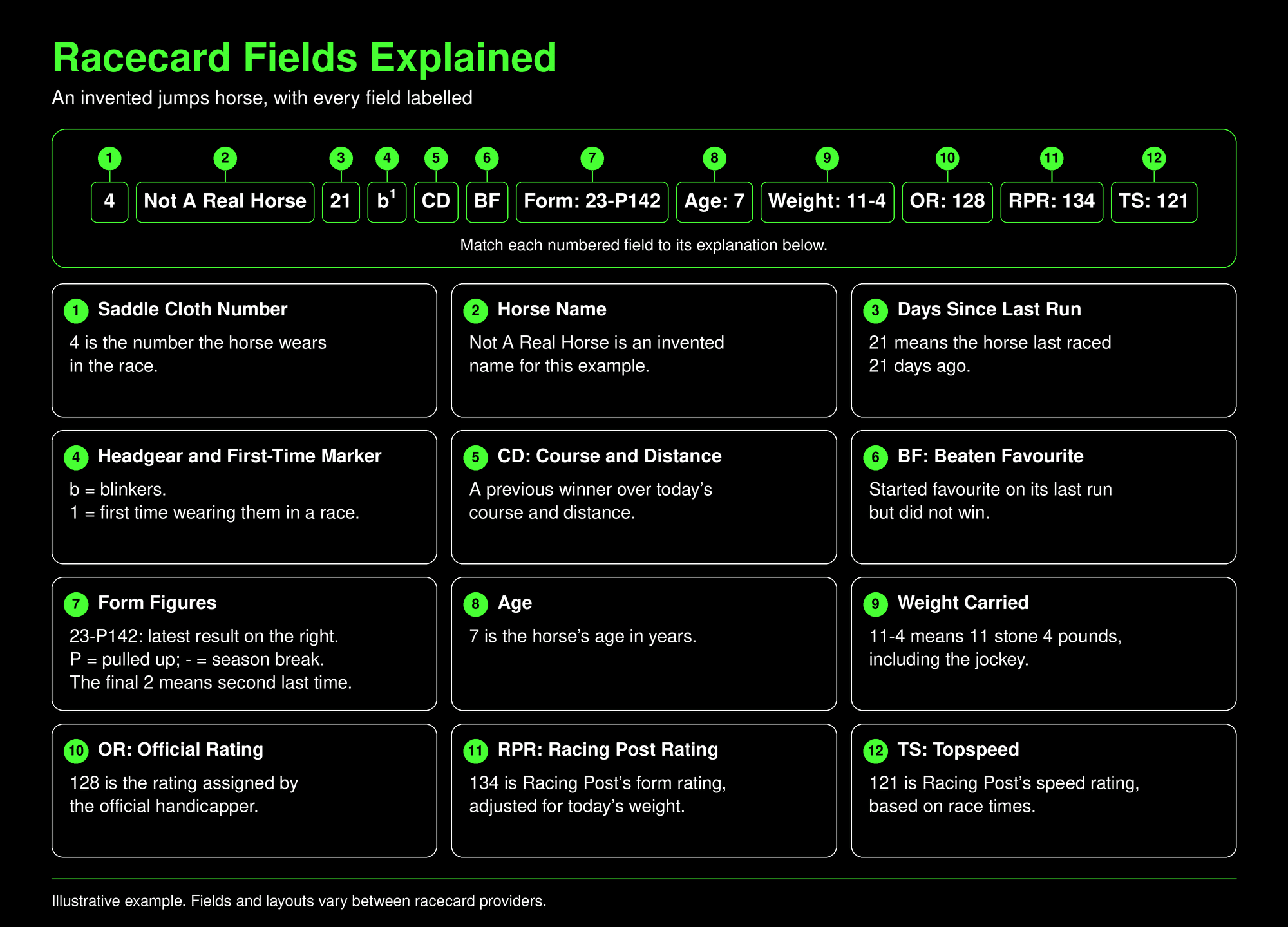
Field by field:
- 4 is the saddle cloth number, the number the horse wears in the race.
- Not A Real Horse is the horse's name, made up for this example.
- 21 is the number of days since it last ran. A letter in brackets after it, such as (F), means its latest run came in a different code, here on the Flat.
- b1 is the headgear: b for blinkers, and the 1 means it's wearing them for the first time.
- CD says it has already won over today's course and distance.
- BF flags a beaten favourite last time out: it started at the shortest price and got beaten.
- 23-P142 is the form. Start on the right: second last time, fourth before that, a win before that, and pulled up before that. The hyphen marks a new season, so 2 and 3 were last season's runs.
- Age: 7 is the horse's age in years.
- Weight: 11-4 is 11st 4lb, the weight it carries today with the jockey included.
- OR: 128 is the official rating, the number the handicapper has given it.
- RPR: 134 and TS: 121 are Racing Post's own rating and its speed figure.
Put that together and you get a seven-year-old in decent form this season, a previous winner at this track over this trip, wearing blinkers for the first time, and turned over as favourite last time. None of it says the horse will win. It tells you which questions the race is asking.
Where each field sits varies between sites, and some cards leave fields out. If you're new to racing betting altogether, how to bet on horse racing covers the basics first.
Form Figures and Letters Explained
What does form mean in horse racing? It's the horse's recent record, a figure or letter for each run, and the figures are only half of it. The letters tell you about the races it didn't finish.
The horse racing form guide symbols below follow the Jockey Club's reading the form key, and most UK cards use the same set.
That's horse racing form explained at the level most cards need. Every letter except P is a jumps code, because those are the ways a horse fails to finish over obstacles.
Watch the case, too. A capital P in the form means pulled up. A small p next to the name is headgear (cheekpieces).
The wider racing vocabulary, from going to Rule 4, is in our horse racing betting terms glossary.
What Does / Mean in Horse Racing Form?
A slash in horse racing form marks a long absence: the horse had a long absence, often a year or more, between the runs on either side of it. A form string ending in a slash, like 1P2/, means it hasn't raced since before that gap.
On Midnite's racecards you'll also see strings that end in a hyphen, like 1/23-. That means the horse hasn't run yet this season.
What Does 0 Mean in Horse Racing Form?
A 0 means the horse finished 10th or worse. Form figures run from 1 to 9 only, so a 0 covers anything from 10th place to last in a big field.
Ratings on a Racecard: OR, RPR and Topspeed
The three ratings on most form sites' racecards are the official rating (OR), the Racing Post Rating (RPR) and Topspeed (TS), and only the first is official.
OR is set by the British Horseracing Authority's handicappers. It's their number for a horse's ability on its form, revised every week, and in a handicap each rating point is worth 1lb. A higher rating means more weight to carry. The BHA's guide to handicapping explains how they arrive at it.
RPR is Racing Post's own rating, compiled by its handicappers and adjusted for the weight the horse carries today. Because it's adjusted to today's race, it's a quick way to compare the field on one scale.
TS, or Topspeed, is Racing Post's speed figure. It compares the times a horse has run with standard times for the course, adjusted for going and weight carried.
Only the OR sets the weights in handicaps. RPR and Topspeed are a publisher's opinion of the form, and Timeform publishes ratings of its own. Ratings judge the quality of the form, and Topspeed judges the clock, so when they disagree it's worth finding out why.
Course, Distance, Going and Headgear
Course, distance, going and headgear codes tell you whether today's race suits the horse.
- C: a previous winner at this course.
- D: a previous winner over this trip, give or take about half a furlong.
- CD: a previous winner over this exact course and distance.
- BF: beaten favourite last time out.
Course form counts for more at some tracks than others. Epsom's camber is the famous example, and a horse that has already handled it has answered one question before the stalls open.
The going is the state of the ground, and it's printed in the race header. Most form sites also show the going for each past run, so you can see whether a horse's best efforts came on soft ground or quick ground. Going changes with the time of year as well as the weather, which our horse racing season guide covers.
Headgear sits next to the horse's name as a lower-case code:
- b blinkers
- v visor
- p cheekpieces
- t tongue tie
- h hood
- e/s eyeshield
- e/c eye cover
A small 1 after the code means it's the first time the horse has worn that headgear. It's one of the first things regulars spot on a card, because it means the trainer has changed something.
How to Study Horse Racing Form
Studying form comes down to one question asked a few ways: do today's conditions suit this horse better or worse than the races its figures came from? These five checks cover most of it.
- Going and distance first. Look at how the horse has run on today's ground and over today's trip. A string of wins on soft ground tells you less on good to firm.
- Class and weight. Check whether it's stepping up or down in class from its recent runs. In a handicap, its official rating sets the weight, so a horse that's risen in the ratings after a win carries more today.
- Recent runs, in context. A fourth in a Grade 1 and a fourth in a low-grade handicap look identical in the figures. Click into the race behind each number.
- Days since last run. A long gap can mean a planned break or a problem, and the form site won't always say which. Some horses run well fresh. Others need a run.
- Trainer and jockey form. Many cards show how the trainer and jockey have done recently, usually as a strike rate.
Form explains a race. It doesn't decide one, and no method turns form study into a sure profit. The price is a separate thing: it's the market's view with the bookies' cut built in, which our overround guide explains.
Where Can I Find a Free Horse Racing Form Guide?
You can read UK and Irish form for free on Racing Post, Sporting Life and At The Races, and Timeform sells more detailed cards. Here's what each one showed when we checked on 22 October 2026. [CONFIRM: re-check free and paid status on the publish day]
What is the best horse racing form guide? There isn't a single answer, but a good one covers every UK and Irish meeting, shows the official rating next to at least one independent rating, prints a key for its symbols, and is clear about what's free.
Midnite's own racecards keep to the basics. Each runner shows its form figures, age, weight, jockey and trainer, and the race header gives the distance, the going, the number of runners and the each-way terms. The place terms follow our published horse racing rules. For official ratings, the draw, days since last run, headgear or course and distance codes, use a form site alongside the card.
Today's meetings are listed on the horse racing meetings page.
Bet Responsibly
Decide what a day's racing is worth to you before you open the first card, and keep it to money you can afford to lose. Studying form can make every race on the card feel like it deserves a bet. Reading six races closely doesn't mean backing six horses.
On Midnite you can set Net Spend Limits by the day, week or month, add a deposit limit or a Loss Limit, or take a Cool Off of one to 30 days, which can't be lifted early. All of them sit in our Responsible Play hub, and GamCare offers free, confidential support. 18+.
FAQs
How to Study Horse Racing Form?
Start with today's going and distance and check how the horse has run on them. Then look at class and weight, the races behind its recent figures, days since its last run, and how its trainer and jockey are going. The full method is above.
Where Can I Find Free Horse Racing Forms?
Racing Post, Sporting Life and At The Races all show form for UK and Irish racing for free, and Sporting Life adds Timeform ratings with a free login. Midnite's racecards show each runner's form figures, age, weight, jockey and trainer.
How to Read a Horse Race Form Guide?
Read the form figures from the right, because that's the latest run. 1 to 9 are finishing positions, 0 is 10th or worse, letters such as F, U and P mean the horse didn't finish, and a hyphen or slash marks a break. Then check the ratings, the C and D codes and any headgear.
One Line at a Time
Start at the right-hand end of the form and work out what today's race is asking. When you've read the card, Midnite's racecards have the runners, the going and the each-way terms in one place.
Midnite is licensed and regulated by the Great Britain Gambling Commission. 18+. Please gamble responsibly.
Away from racing, Midnite partners the World Snooker Tour, is the NFL's official sports betting partner in the UK and Ireland, and is principal partner of Wolves, Middlesbrough and Sheffield United for 2026/27.
About the author
Jordan Willmott is Sportsbook Experience Senior Manager at Midnite, where he leads the team behind sportsbook operations and propositions, from bet settlement and price boosts to the range of markets and specials available across every sport on site. He has spent 13 years in sportsbook and trading, previously in similar roles at BetVictor, Sporting Index and Sky Betting & Gaming. He writes here on how markets are built, made available and settled once the whistle goes. Connect with Jordan on LinkedIn.


Company
Help
Product
Support
Payment Methods


Play Responsibly
Midnite is operated by Midnite Limited for customers in Great Britain, licensed and regulated as an online gambling operator in Great Britain by the British Gambling Commission under licence number 101839 as well as Gibraltar by Government of Gibraltar and the Gibraltar Gambling Commissioner, under licence number RGL 176 and RGL 177 and Midnite Europe Limited for customers in Ireland, licensed by the Gambling Regulatory Authority of Ireland (Licence No. GRAI-0767-RB-26-0001 ).
Midnite Limited is incorporated under the laws of Gibraltar, with Company Registration No.126682, and registered address at Unit 1-3 Irish Place, Gibraltar, GX11 1AA, Gibraltar. Midnite Europe Limited is incorporated under the laws of Malta, with Company Registration No.C90791, and registered address at Level 3 (suit 2327) Tower Business, Tower Street, Swatar Birkirkara BKR4013, Malta. Please play responsibly, for more information and advice visit: www.begambleaware.org or www.gamblingcare.ie