Horse Racing Betting Terms: A UK Glossary From Ante-Post to Yankee
Horse racing betting terms explained: each-way, SP, BOG, Rule 4, NAP, form figures like UR and PU, and slang from pony to carpet. UK racing terms only.
By Jordan Willmott, Sportsbook Experience Senior Manager at Midnite
Last updated: 30/10/2026
Horse racing betting terms are the shorthand you'll meet on every racecard and bet slip: each-way, SP, Rule 4, a pony, a carpet. This glossary sticks to UK racing, defines more than 80 terms grouped by theme, and sits alongside our guide to betting on horse racing.
Horse Racing Betting Terms Explained
Each term below gets a line or two, grouped by where you'll meet it: the bet, the price, the payout rules, the racecard, the race and the slang. The most searched terms get short answers of their own, and where Midnite's horse racing rules change a term, we say so.
- Bet types: win, each-way, multiples, NAP
- Odds and prices: SP, BOG, bar, NRNB
- Places, payouts and rules: place terms, Rule 4, dead heats
- Racecard and form: going, official ratings, UR, PU, BF, CD
- Race types: Flat, jumps, handicaps, Group and Grade races
- Betting slang: pony, monkey, carpet and the rest
You won't find show or exacta here. They're American pool bets, and they don't work the same way on a British bet slip.
The Midnite Take: Horse Racing Lingo, Without the Paddock Politics
By Dave Learmont, Creative Copy Lead at Midnite
Horse racing has its own language. And if you've ever heard someone discussing a non-runner, an each-way bet and a going description in the same breath, you'll know it can sound like a completely different sport.
A favourite is the horse with the shortest odds. Each-way means splitting your stake between a win bet and a place bet. The going describes the ground conditions, which can make a real difference to how a horse performs.
You don't need to sound like a racing commentator to follow what's happening. Just understand the basics before the horses leave the stalls.
Bet Types
The bet type decides what your horse has to do for you to get paid: win, finish placed, or come in alongside other selections. These are the ones on a UK bet slip, and our horse racing betting guide walks through placing each one.
- Win: your horse has to finish first. Second by a short head still loses.
- Double and treble: two or three selections linked in one bet, and every one has to win. At Midnite, a non-runner drops out and a treble settles as a double.
- Accumulator (acca): one bet linking several selections, all of which have to win. Our accumulator explainer covers how the returns stack.
- Full-cover bet: a set of multiples covering every combination of your selections, so one loser doesn't sink everything.
- Trixie: three selections, four bets (three doubles and a treble).
- Patent: three selections, seven bets (a Trixie plus three singles).
- Yankee: four selections, 11 bets (six doubles, four trebles and a fourfold), no singles.
- Lucky 15: four selections, 15 bets, which is a Yankee plus four singles. Our Lucky 15 guide has worked returns.
- Lucky 31: five selections, 31 bets, singles through to a fivefold.
- Forecast and tricast: picking the first two, or first three, home in the right order. Midnite doesn't currently offer either.
- Tote: pool betting, where stakes go into a pot, a deduction is taken and the rest is shared between winning tickets.
- Placepot: a Tote bet on the first six races of a meeting, needing a placed horse in every one. Not currently offered at Midnite.
- Banker: a tipster's word for a selection they're most confident in. Confidence isn't a result, and a banker loses like any other bet.
At Midnite, full-cover bets are horse racing only, each-way versions are available, and the stake is multiplied by the number of bets, so a £1 Lucky 15 costs £15. On the bet slip, the figure for a full-cover bet is labelled Max Return, the most the bet can pay. There's no consolation or bonus payout on top. The special multiples help article lists every combination.
What Does Each Way Mean in Horse Racing?
Each way means two bets of the same stake on one horse: one to win and one to place. So £5 each way costs £10. If the horse wins, both halves pay. If it only places, the place half pays at a fraction of the odds and the win half loses.
The fraction and the number of places depend on how many runners take part, and Midnite's terms are in the table under Places, Payouts and Rules. Our each-way explainer goes through the maths step by step.
What Is a NAP?
In horse racing, NAP means a tipster's strongest selection of the day, the one they'd keep if they could only pick once.
It's a label for confidence, nothing more. A NAP is still a single selection at a price, and it can lose like anything else on the card. Our NAP of the day page explains where the term turns up.
Odds and Prices
Odds and prices tell you what a winner pays relative to your stake. UK racing quotes them as fractions: at 5/1, every £1 staked wins £5, plus the stake back. Betting odds explained has the full workings.
- Evens: a price of 1/1, where the winnings match the stake.
- Odds-on: a price shorter than evens, such as 1/2, where you stake more than you can win.
- Odds-against: a price bigger than evens, such as 3/1.
- Favourite: the horse with the shortest price in the race.
- Joint favourites: two or more horses sharing the shortest price.
- Jolly: another word for the favourite.
- Outsider: a big-priced horse the market doesn't rate as likely to win.
- Steamer: a horse whose price shortens sharply before the off.
- Drifter: a horse whose price gets bigger before the off.
- Taking a price: fixing the odds at the moment you bet, whatever happens to the market afterwards.
- Overround: the margin built into a race's prices. Across a race, the prices always cover more than one winner, and the extra is the bookies' cut.
- Ante-post: a bet struck well before race day, usually before the final declarations. Prices can be bigger, but a non-runner usually loses unless the market is non-runner no bet. Midnite doesn't offer ante-post betting.
- Odds Boost: Midnite's pre-set boosted prices. If any runner in a boosted or special racing market is a non-runner, the whole bet is void. More in our Odds Boost guide.
What Does SP Mean in Horse Racing?
SP means starting price: the price a horse is at the moment the race starts. If you take SP rather than a fixed price, you're paid at whatever the starting price turns out to be, bigger or smaller than when you bet. That's the SP bet meaning: whatever price it goes off at.
At Midnite, Rule 4 can apply to SP bets too, when there wasn't time to re-form the market before the off. Our SP explainer covers how the price is set.
What Does BOG Mean?
BOG means Best Odds Guaranteed in horse racing: if you take a price and the SP comes back bigger, you're paid at the SP. It takes the sting out of watching a horse you've backed drift in the betting. At Midnite, BOG is by invitation only, and eligible customers are told.
Midnite's BOG terms, as published in the horse racing and greyhound rules:
- UK and Irish horse racing only. Greyhounds and other countries are excluded.
- Bets placed from 9am on race day, before the race.
- Win and each-way, singles and multiples.
- Boosted odds, specials, ante-post bets and races carrying another promotion such as Extra Places are excluded.
- The extra paid by BOG is capped at £50,000 per customer per day.
Comparing concessions like BOG between bookies is covered in how to evaluate horse racing betting providers.
What Does Bar Mean in Horse Racing?
Bar means every horse not named in a betting show is at that price or bigger. "20/1 bar" tells you the unnamed runners are all 20/1 or longer. "4/1 bar two" means you can get at least 4/1 about anything except the two at the top of the market.
What Does NRNB Mean?
In horse racing, NRNB means non-runner no bet: if your horse doesn't run, the bet is void and your stake comes back. It's a concession some bookies add to ante-post markets for big races, where the usual risk is losing the stake on a horse that never makes the line-up.
Midnite doesn't offer ante-post betting, so you won't see NRNB on our racecards.
Places, Payouts and Rules
Place terms and settlement rules decide what a racing bet actually returns: how many places pay, at what fraction, and what happens when a horse is withdrawn or two finish together. Midnite's versions are published in its racing rules.
- Placed (in the frame): finishing in one of the positions that pay out on the place part of a bet.
- Place terms: the number of places paid and the fraction of the odds they pay at, such as 1/5 for three places.
- Extra Places: a promotion on selected races that pays one place more than standard on each-way bets. It can change or be withdrawn if there are non-runners.
- Non-runner: a horse withdrawn after you've bet. At Midnite, a single on a non-runner is void and the stake comes back. In a multiple, it drops out and the rest of the bet stands.
- Void bet: a bet cancelled by the rules, with the stake returned.
- Walkover: a race with one horse, which still has to pass the winning post. Midnite treats walkovers as non-runners.
- First past the post: on UK and Irish racing, Midnite pays on both the official result and the horse that crosses the line first, with exceptions such as an objection by the Clerk of the Scales.
- Weighed in: the announcement that confirms the result. Midnite settles on the official result at the weigh-in, and later changes don't affect it.
- Stewards' enquiry: a review of whether a rule was broken during the race.
- Photo finish: when the judge needs the finish-line camera to separate the placings.
- Cash out: settling a bet early for an amount offered before the result. Our cash out guide explains how offers are worked out. At Midnite, cash out isn't available on SP bets.
Midnite's standard each-way place terms, set by the runners that actually take part:
Worked example: £2 each way at 10/1 in an 18-runner handicap, so four places at 1/4 odds and £4 staked in total.
- Your horse wins? The win half returns £22 and the place half returns £7 (10/1 at a quarter is 5/2). Total back: £29.
- Finishes third? The place half returns £7. The win half loses.
- Finishes fifth? Both halves lose, and the £4 is gone.
Rule 4 is a deduction from the winnings on a horse when another runner is withdrawn after you've bet, because the race just got easier to win. The deduction depends on the withdrawn horse's price, from 90p in the £ for a 1/9 shot down to 5p for one between 10/1 and 14/1. At Midnite, combined deductions are capped at 90p in the £.
Say you take 6/1 with £10 in the morning, and a horse priced 5/2 is withdrawn at lunchtime. A 5/2 non-runner means a 25p in the £ deduction. Your horse wins, the £60 winnings lose £15, and you get £45 winnings plus your £10 stake back: £55.
Dead heat means two or more horses finish level. Your stake is divided by the number in the dead heat and settled at full odds, so £10 on a 6/1 winner in a two-way dead heat becomes £5 at 6/1, returning £35.
Racecard and Form Terms
A racecard lists every runner in a race with its form, weight, rating and connections, and most of it arrives as abbreviations. Form is read left to right, oldest run first, most recent last.
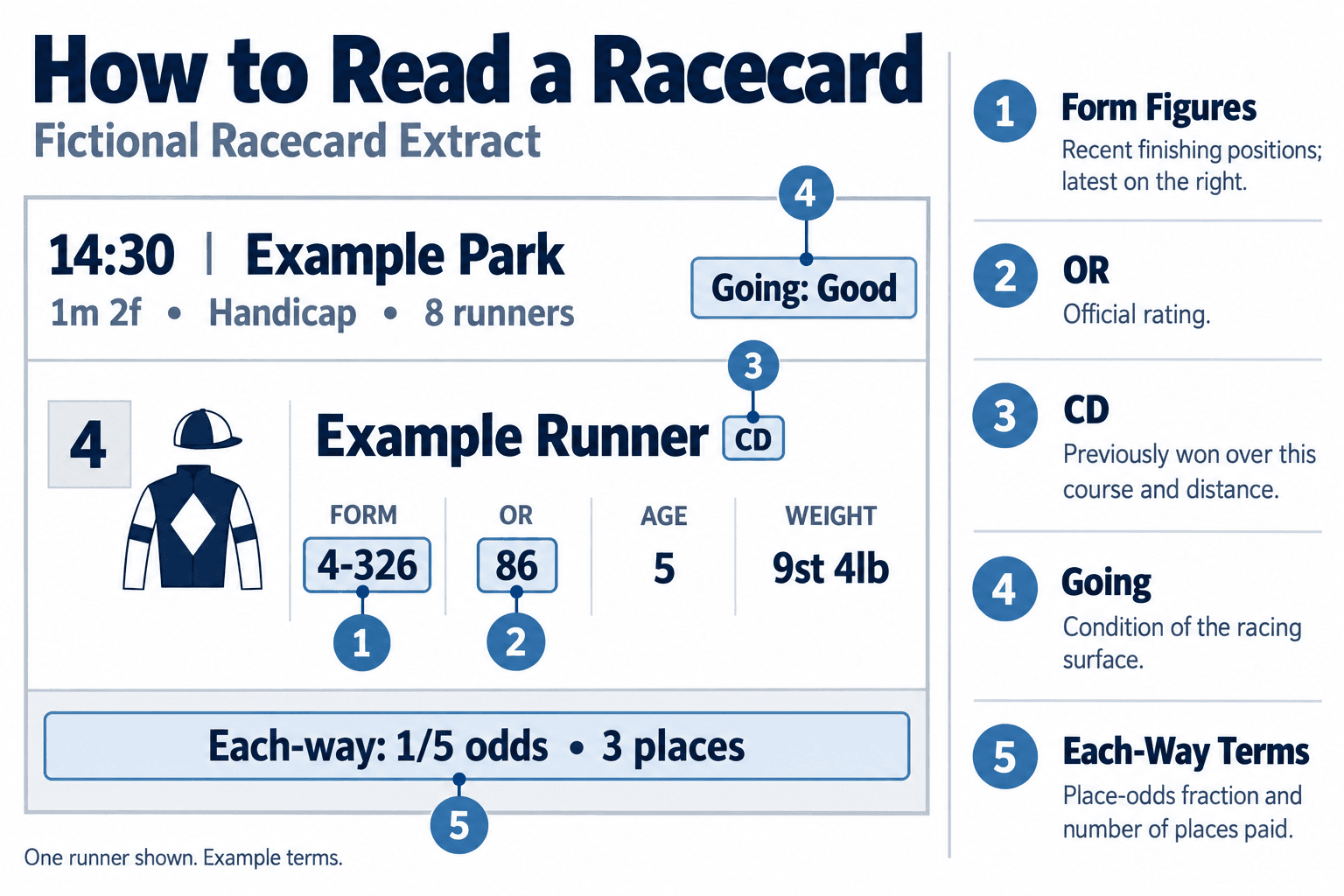
- Going: the state of the ground. On turf it runs hard, firm, good to firm, good, good to soft, soft and heavy. All-weather tracks use fast, standard to fast, standard, standard to slow and slow.
- All-weather: a synthetic surface, raced on all year round.
- Furlong: an eighth of a mile, 220 yards. Race distances are given in miles and furlongs.
- Draw: the starting stall a horse is given in a Flat race, usually allocated at random. Jumps races don't start from stalls.
- Weight: what a horse carries, jockey and saddle included. Top weight is the horse carrying the most in a handicap.
- Official rating (OR): the British Horseracing Authority handicapper's number for a horse, which goes up after good runs and down after poor ones. It sets the weight in handicaps.
- Form figures: finishing positions from recent runs, one character per race. 1 to 9 is where it finished.
- 0: finished outside the first nine.
- Dash (-): separates racing seasons, with the earlier season on the left.
- Slash (/): marks a longer gap, such as a missed season.
- F: fell.
- B or BD: brought down by another runner.
- R: refused at a fence or hurdle.
What Does UR Mean in Horse Racing?
UR means unseated rider: the horse parted company with its jockey during the race, without falling itself. You'll see it as U or UR in a form line, almost always from jumps racing.
A UR doesn't always say much about the horse. One blunder can unseat a jockey on a horse travelling well.
What Does PU Mean in Horse Racing?
PU means pulled up: the jockey stopped the horse before the finish, usually because it was tired, struggling or not right. It shows as P or PU in the form.
One PU on heavy ground can be a one-off. Several in a row tell a different story.
What Does BF Mean in Horse Racing?
BF means beaten favourite: the horse started favourite last time out and didn't win. It appears next to the horse's name on many racecards rather than inside the form figures.
What Do C, D and CD Mean?
C means the horse has won on this course before. D means it has won over this distance before. CD means it has won over this course and distance in the same race. On a track with a quirk, like the tight bends at Chester Racecourse, plenty of racing fans give CD a second look.
Race Types
British racing splits into Flat and jumps, and each has its own ladder of race classes. The racing season guide covers when each one runs.
- Flat: racing without jumps. The turf season runs from spring to autumn, and all-weather Flat racing carries on through the year.
- National Hunt (jumps): racing over hurdles or fences.
- Hurdle: a race over smaller, lighter obstacles than fences.
- Chase (steeplechase): a race over fences, which can include open ditches and water jumps.
- Bumper: a National Hunt Flat race, run under jumps rules without obstacles, to give young horses experience.
- Handicap: a race where horses carry different weights based on their official ratings, to even out the field.
- Maiden: a horse that hasn't won yet, and a race restricted to them.
- Novice: a horse early in its career, and a race for that stage.
- Juvenile: a two-year-old horse.
- Listed: the class just below Group or Grade races.
- Group 1, 2 and 3: the top tier of Flat racing, with Group 1 the highest. The British Classics are Group 1s.
- Grade 1, 2 and 3: the jumps equivalent. The Cheltenham Gold Cup is a Grade 1.
Greyhound racing has its own terms and rules. See how to bet on greyhounds.
Betting Slang
Racing slang covers two things: money and prices. Pony is betting slang for £25, and monkey is £500. Price slang comes from tic-tac, the hand signals on-course bookies once used to pass prices along the betting ring.
Bet Responsibly
Set your budget for the day before the first race, and keep it to money you can afford to lose. A full Saturday card plus an evening meeting is a lot of races, and the budget should cover all of them rather than resetting at each one.
At Midnite, Net Spend Limits can be set daily, weekly or monthly, and Cool Off lets you step away for one to 30 days with no way to lift it early. You can set a deposit limit too, and every tool is in the Responsible Play hub, and BeGambleAware offers free, confidential support.
FAQs
What Are the Different Types of Bets in Horse Racing?
The main types of bets in horse racing are win, each-way, multiples such as doubles, trebles and accumulators, and full-cover bets such as the Yankee and Lucky 15. Forecasts, tricasts and Tote bets exist too, but Midnite doesn't currently offer them.
What Are Some Common Phrases Used in Horse Racing?
Common phrases include "the jolly" for the favourite, "a steamer" for a horse being backed in, "a drifter" for one going out in the betting, "20/1 bar" for the price of the unnamed runners, and money slang like a pony (£25) and a monkey (£500).
What Are Some Basic Terms Used in Horse Terminology?
The basic horse betting terms a beginner needs are win, each-way, odds, favourite, SP and non-runner. Learn those six and most bet slips make sense. Place terms and Rule 4 come next, because they change what a bet returns.
What Are Some Common Terms Used in Racing Jargon?
Racecard jargon is mostly abbreviations: the going for the ground, OR for official rating, CD for a course and distance winner, BF for beaten favourite, and form letters like F (fell), UR (unseated rider) and PU (pulled up).
Under Starter's Orders
Most horse racing terms are older than the bet slip, and they still decide what yours pays. When you're ready to put them to use, the full card is on Midnite's horse racing page.
Midnite is licensed and regulated by the Great Britain Gambling Commission. 18+. Please gamble responsibly.
Off the track, Midnite is principal partner of Wolves, Middlesbrough and Sheffield United for 2026/27, Southampton's training kit partner, and a partner of both the World Snooker Tour and the NFL.
About the author
Jordan Willmott is Sportsbook Experience Senior Manager at Midnite, where he leads the team behind sportsbook operations and propositions, from bet settlement and price boosts to the range of markets and specials available across every sport on site. He has spent 13 years in sportsbook and trading, previously in similar roles at BetVictor, Sporting Index and Sky Betting & Gaming. He writes here on how markets are built, made available and settled once the whistle goes. Connect with Jordan on LinkedIn.


Company
Help
Product
Support
Payment Methods


Play Responsibly
Midnite is operated by Midnite Limited for customers in Great Britain, licensed and regulated as an online gambling operator in Great Britain by the British Gambling Commission under licence number 101839 as well as Gibraltar by Government of Gibraltar and the Gibraltar Gambling Commissioner, under licence number RGL 176 and RGL 177 and Midnite Europe Limited for customers in Ireland, licensed by the Gambling Regulatory Authority of Ireland (Licence No. GRAI-0767-RB-26-0001 ).
Midnite Limited is incorporated under the laws of Gibraltar, with Company Registration No.126682, and registered address at Unit 1-3 Irish Place, Gibraltar, GX11 1AA, Gibraltar. Midnite Europe Limited is incorporated under the laws of Malta, with Company Registration No.C90791, and registered address at Level 3 (suit 2327) Tower Business, Tower Street, Swatar Birkirkara BKR4013, Malta. Please play responsibly, for more information and advice visit: www.begambleaware.org or www.gamblingcare.ie