


The Built Different Index: Shortest Away Trip
A local derby should be simple. Roll out of bed. Question your life choices. Get on a train. Spend 90 minutes shouting at people who live 20 minutes away. That’s the theory, anyway. For some clubs, the nearest away day is practically next door. For others, “local” is doing some very heavy lifting.
By Dave Learmont
The Shortest Away Trip factor ranks all 92 clubs by the distance to their nearest league opponent. The further that closest trip is, the higher the club ranks.
Why? Because if even your easiest away day needs planning, snacks, a suitcase and possibly a hotel, your geography is doing half the work for you.
This ranking is based on the clubs competing across the Premier League and EFL in the 2025/26 season, so every “nearest away trip” reflects that season’s league make-up. Promotion and relegation can completely redraw the map.
And this table has produced some absolute nonsense.
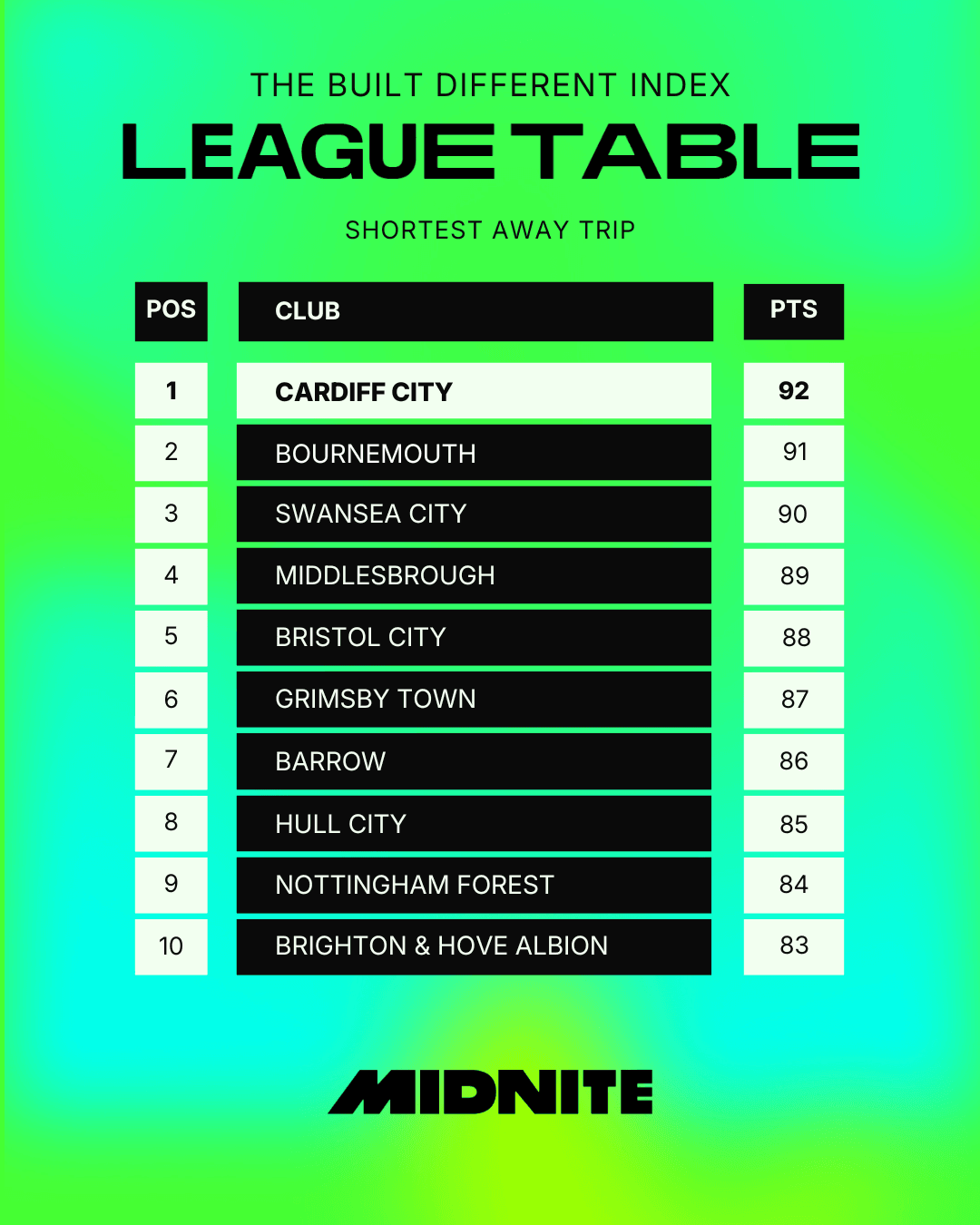
Cardiff City: local derby pending
Top of the table are Cardiff City, whose shortest league away trip is to Reading.
That’s 104 miles.
Read that again.
Their nearest away day is more than 100 miles away.
For most clubs, 104 miles is an annoying one. For Cardiff, it’s the easy option. That puts them first in the Shortest Away Trip ranking, jumping 43 places from their overall Built Different position.
The phrase “nice little local one” should not require a full tank of petrol.
Bournemouth are isolated in style
Second are Bournemouth, whose closest away fixture is Brighton at 97.2 miles, which feels less like a derby and more like a polite regional association.
No short hop to Southampton. No quick run along the coast. Just the AmEx Stadium, nearly 100 miles away, because the 2025/26 league line-up has decided geography is somebody else’s problem.
Bournemouth rise five places from their baseline ranking to take second spot.
Swansea and Middlesbrough complete the “nearest is still nowhere near” club
Swansea City come third, with Bristol City their closest trip at 78 miles.
Middlesbrough are fourth, with Hull City 75 miles away.
Neither journey is outrageous by football standards.
But as your shortest trip?
That’s grim.
It means every single league away day is at least that inconvenient. No proper local. No quick one. No fixture where you can leave after lunch and be home for the takeaway.
Just miles. Lots of them.
Bristol City and Grimsby both land on 71 miles
Fifth-placed Bristol City have Oxford United as their nearest league opponent, 71 miles away.
Then comes Grimsby Town, also on 71 miles, with Chesterfield their closest trip.
Grimsby climb a huge 44 places from their baseline ranking to sixth.
That’s one of the clearest examples of what this factor does: it takes a club that sits mid-table overall and suddenly reveals just how geographically cut off it is from the rest.
Not remote enough to be romantic. Just remote enough to be a pain.

Nottingham Forest are the biggest risers
The biggest jump belongs to Nottingham Forest.
They move from 80th overall to ninth here, a rise of 71 places.
Their shortest league away trip is Aston Villa, 48.2 miles away. That’s not exactly Cardiff-level isolation, but compared with clubs surrounded by neighbours, it’s enough to send them flying up the table.
Forest are one of those clubs that feel central until you actually look at the fixture list. Then, suddenly, the “local” options start thinning out.
Brighton fall, but not too far
Overall Built Different champions Brighton & Hove Albion drop to tenth in this factor, with their nearest trip being Crystal Palace at 46 miles, which also just so happens to be one of the weirdest ‘rivalries’ in the country.
Not exactly around the corner, but still close enough for both sets of fans to spend the entire week pretending the rivalry does not matter that much.
It does.
Obviously.
The South West still hates convenience
Exeter City and Plymouth Argyle sit 13th and 14th respectively. Their nearest league trip is each other, at 44 miles.
That’s a short hop & a skip by their standards, which is saying something.
For clubs in the South West, 44 miles probably counts as popping out. The rest of the calendar tends to look more like an intercity logistics exercise.
Ipswich and Norwich: finally, a proper one
Ipswich Town and Norwich City come 15th and 16th, with the two grounds 43 miles apart, which feels more like it.
That’s close enough to feel regional, but far enough to harbour a lot of pent up resentment.
Perfect derby distance, really.
You can get there without ruining the weekend, but not so easily that anyone becomes civil about it.
Some clubs rise because they barely have neighbours
A few names fly up this table because their nearest opponent is still miles away:
- Colchester United rise 58 places, with Cambridge United 45 miles away.
- Milton Keynes Dons rise 61 places, with Barnet 42 miles away.
- Northampton Town rise 67 places, with Luton Town 37 miles away.
- Walsall rise 68 places, with Shrewsbury Town 37 miles away.
- Tranmere Rovers rise 59 places, with Salford City 36 miles away.
This is where the factor becomes less about glamour and more about football’s strange map.
Some clubs sit in areas packed with opponents, while others simply look around and see dual carriageway.
The middle of the table: actual normal distances
From about the low 30s onwards, the trips start looking like what most people would call local.
- Crewe to Shrewsbury: 33 miles.
- Burton to Port Vale: 32 miles.
- Cheltenham to Swindon: 31 miles.
- Gillingham to Bromley: 28 miles.
- Mansfield to Rotherham: 26 miles.
These are believable.
You could leave in the afternoon and still get there before the stewards start looking nervous.
Nothing Built Different about that.
Just football.
Then come the actual derbies
At the sharp end of the shortest-distance table, the proper rivalries start appearing.
- Portsmouth and Southampton are 18 miles apart.
- Aston Villa and Wolves: 14.1 miles.
- Newcastle United and Sunderland: 12.1 miles.
- Blackburn Rovers and Preston North End: 10 miles.
- Bolton Wanderers and Wigan Athletic: 8 miles.
- Manchester City and Manchester United: 5.2 miles.
- Arsenal and Tottenham Hotspur: 4 miles.
- Sheffield United and Sheffield Wednesday: 4 miles.
This is where away travel becomes less about endurance and more about emotional damage.
You can barely finish your pre-match coffee before entering hostile territory.
Arsenal take the biggest fall
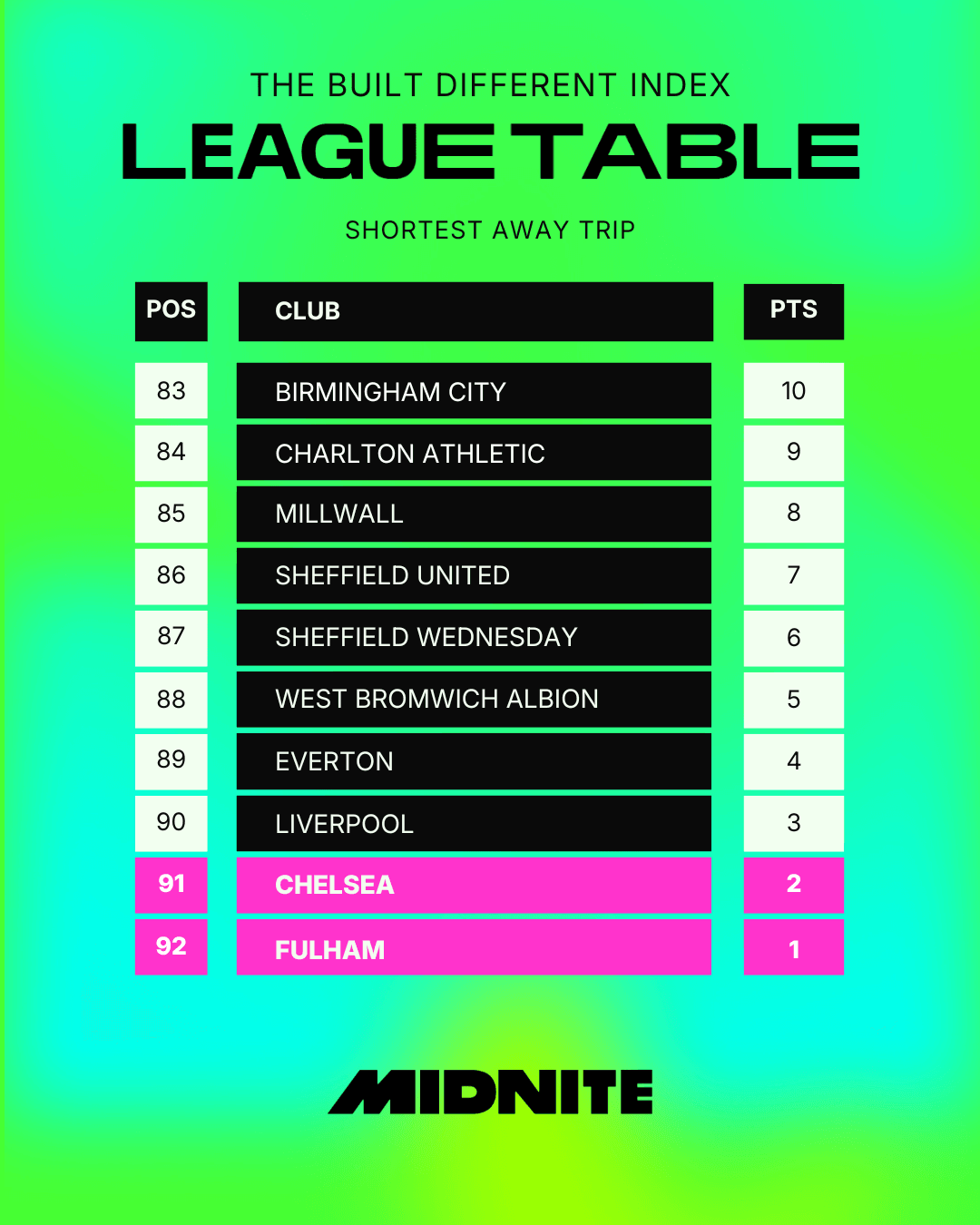
The biggest fall belongs to Arsenal, dropping 71 places from tenth overall to 81st. Their closest away trip is Tottenham, just 4 miles away.
Unfortunate for the ranking. Great for the rivalry.
A North London derby is exactly what this factor punishes: two giant clubs, one city, minimal travel, maximum noise.
Arsenal are very much Built Different overall, just… not when it comes to getting on the coach.
Liverpool and Everton barely need one
Everton and Liverpool sit 89th and 90th.
Their grounds are 2.2 miles apart. That is less an away day and more a change of postcode.
Liverpool drop 71 places, matching Arsenal for the biggest fall. Everton fall 43.
For supporters, it’s ideal. No motorway. No service station. No arriving home at 2am because someone has closed half the rail network.
For this table, it’s a disaster.
Chelsea and Fulham finish joint-bottom
At the very bottom are Chelsea and Fulham. Stamford Bridge and Craven Cottage are just 1.5 miles apart, which is barely an away trip.
That’s a brisk walk at best.
To be honest, it’s genuinely quicker to go on foot than take the team coach. Fulham finish 92nd, with Chelsea one place above in 91st.
The closest thing in the entire league system to an away day that does not really count as away.
So, what does the Shortest Away Trip table tell us?
It tells us football geography is deeply unfair.
Some clubs can lose an away derby and be home before the phone-in starts.
Others have to travel 100 miles just to reach their nearest opponent.
That affects fans.
It affects atmosphere.
It affects how rivalries form.
And it affects what “local” even means.
For Cardiff, local means Reading a whole other country away. For Chelsea, it means Fulham, the next post code.
We reckon that’s a bit bonkers.
That’s exactly what the Built Different Index is for.
Because football isn’t just about where you finish. Sometimes, it’s about how far you have to go before you even start.
The Full Table



Company
Help
Product
Support
Payment Methods


Play Responsibly
Midnite is operated by Dribble Media Limited for customers in Great Britain, licensed and regulated by the Great Britain Gambling Commission (Account No. 42647 ) and Midnite Europe Limited for customers in Ireland, licensed by the Gambling Regulatory Authority of Ireland (Licence No. GRAI-0767-RB-26-0001 ).
Dribble Media Limited is incorporated under the laws of England and Wales, with Company Registration No.09555672, and registered address at 86-90 Paul Street, London, EC2A 4NE United Kingdom. Midnite Europe Limited is incorporated under the laws of Malta, with Company Registration No.C90791, and registered address at Level 3 (suit 2327) Tower Business, Tower Street, Swatar Birkirkara BKR4013, Malta. Please play responsibly, for more information and advice visit: www.begambleaware.org or www.gamblingcare.ie


